John Fowles - Biography and Works
John Fowles (1926-2005), a British modern novelist, was born in Leigh-on-Sea, in the southeast of England, as the son of Robert Fowles, a prosperous cigar merchant, and Gladys Richards Fowles. Fowles received his formal education at Alleyn Court School and Bedford School. Later, Fowles lamented that as a captain of prefects at Bedford School, he allowed himself to exercise dictatorship over the younger boys. During World War II, his family banished to a small Devonshire village near Dartmoor.
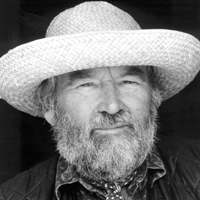
John Fowles (1926-2005)
In 1944, he enrolled in the University of Edinburgh. From 1945 to 1946, he worked for the Royal Marines. He then studied French, and German languages and literature at New College, Oxford. While he was at Oxford, he was much inclined by the French Existentialism, the most fashionable philosophical movement at that time. After receiving his B.A. In 1950, Fowles started instructing as a teacher at the University of Poitiers in France, and at a boys' school at the Anargyrios College on the Greek island Spetsai. There he met with Elisabeth Whitton; they married in 1956.
In England, he persistently moved his career as a teacher at Ashridge College from 1953 to 1954 and at St. Godric's College he instructed for ten long years i.e. from 1954 to 1963. He involved himself in many writing projects. One of them is a novel called The Magus (1965). It is said that he continued to revise it for 13 years. It is one postmodern novel telling about Nicholas, who is a teacher by profession but is confused in the psychological illusions of a master trickster, which become increasingly dark and serious. He published its revised version in 1977.
As a novelist Fowles made his debut with The Collector (1963), a mixture of thriller and an analysis of class conflict. It is about the abduction and imprisonment of Miranda by Frederick Clegg. It was first told from his point of view, and then from Miranda’s view point by the means of the diary she has kept, and last part of the narration is again taken up by Clegg about her illness and death. Jud Kinberg and John Kohn, former television writers, bought the screen rights of the book before its publication. William Wyler agreed to direct the picture.
The Collector gained a huge success and since its publication. Fowles devoted himself entirely to writing. After winning a national football lottery, he uses his winnings to purchase a secluded Tudor mansion with a fortress like a cellar. His another successful novel was The French Lieutenant’s Woman, set largely in Lyme Regis in the 1860s. He has re-created the Victorian melodrama and the world of Thomas Hardy. In the story, Charles Smithson, a supporter of Darwin's evolution theory, falls in love with Sarah Woodruff, despite his engagement with Ernestina. Sarah is believed to be deserted by a French naval lieutenant. She bears the title of the novel. Ernestina Freeman’s conformity contrasts to Sarah's rebelliousness. Fowles moves between past and present, adds footnotes, quotations from Darwin, Marx, and the greats Victorian poets, and comments Victorian politics and customs. This experimental, self-conscious novel has multiple endings, one expected and traditional and another shocking and unconventional.
John Fowles is a writer of metafiction. He has pushed one step further the experimental vigour of postmodernism. As a writer of experimental fiction Fowles made room for experimental postmodernism in the art of fiction writing. By the time John Fowles began to write, the domain of fiction - writing was already affected by the experimental excitement. Most of the contemporaries of John Fowles had been making different kinds of experiments. The experiment was largely directed towards the traditional narrative structure. Even the experimental fervor of 1960-1970 entered into the domain of characterization. John Barthes had, with a great deal of success, been making a creative use of experimentation. John followed the line of postmodernist writers who wrote a lot on the subject of the fiction of fiction.
Fowles also come to the same postmodernist fervour of interrogating the traditional narrative structure. Affected by the 1960’s wave of experimental postmodernism, John Fowles wrote metafictions, which altered out traditional view on the relationship between the author and the work of fiction he/she creates.
As a postmodern novelist Fowles captures the changing direction and experimental trend in the broad field of fiction writing. John Fowles is an experimental writer of metafiction in the postmodern context. He is a new trend-setter in the art of fixing the opening and the end of narrative structure. The end of narrative structure is radically altered by John Fowles. He interrogates narrative structures. He gives a unique twist to the narrative ending. Fowles is a writer of metafiction because he questions the fictionality of fiction. He is a postmodern writer because he interrogates the elusive nature of truth. As a writer John Fowles alters the traditional viewpoint a writer is expected to adopt to render his narrative far more intact. When the world view of people change, when life-view of an individual changes, the art of imagination also change. With a change in society, an individual also allows a certain degree of change within him. A writer who is aware of this change around the world and in the individual tries to distrust the traditionalism of the artistic convention. John Fowles is said to have captured this trend of change in the orbit of perception. John Fowles caught a glimpse of new perceptivity around the changing order of society.