Nietzsche's Apollonianism and Dionysiansism: Meaning and Interpretation
Nietzsche's Apollonianism and Dionysianism is one of the philosophy in which he has presented serious concept of two forces prevalent in the human world. They are Apollonianism and Dionysianism they come from the word Apollo and Dionysus. They are the names of Gods worshiped by Greek people and these two Gods represent two different qualities. Apollo stands for beauty, order, harmony, love, progress, serenity, calmness and individualism while Dionysus stands for ugliness, disorder, hatred, passion, emotion, intoxication and group.
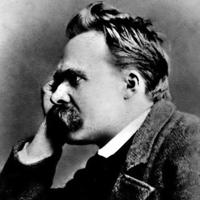
Friedrich Nietzsche (1844-1900)
Nietzsche studies about such opposite feature in these two Gods and made a theory that there are Apollo like as well as Dionysus like qualities found everywhere in the human world. All the qualities of Apollo are called Apollonianism and qualities of Dionysus are Dionysianism. He also says that such contradiction qualities are found everywhere; they are psychological forces alternatively dominating individual mind, the culture as well as the art and the artist. Nietzsche says that human mind is sometimes Apollonianism and sometimes Dionysianism even a culture is the product of both Apollomianism & Dionysianism.
Even an artist can be either Apollonian or Dionysus art because Apollo and Dionysus are art sponsoring Gods. The Apollonian art is plastic while Dionysian art is non-plastic. In Nietzsche’s view, the naive art is the non-plastic. In Nietzsche’s view, the naïve art is the dualistic combination with balance between Apollonianism and Dionianism. In other words, what Nietzsche says that the balance of Apollonianism as well as Dionysianism in an art makes it as the credit example of the best art. Tragedies as the examples of naïve art as in this tragedies there is dualistic balance between Apollonian and Dionysian qualities. Such reconciliation between Apollonian and Dionysus quality gives birth not only to the best art but also to the best culture development.
Nietzsche also describes that Apollo and Dionysus are also the Gods related to individual and throng or mob. He says that Apollo is the God of individual because an individual is dominated by Apollonian qualities such as order, harmony, intellect etc. But, the throng or the mob or the collective is related to Dionysus. Dionysus qualities such as intoxication, passion, chaos, disorder are connected with the collective. Generally, when an individual is alone, he is in the collective he becomes passionate and intoxicated as if he has drunk wine. He looses his personal identity and like a maddened person, he behaves mysteriously so Nietzsche calls that there is mystical experience in the collective. Why the mass or the collective behaves so mysteriously is really a surprising but Nietzsche says that it is because of Dionysus dominating the collective. As the collective or the throng is associated with God Dionysus, it is so mystically intoxication.
Nietzsche also describes about dream and illusion and even connects them with Apollonianism and Dionysianism. As long as dream concerns, he talks about real dream and daydreaming. Day dreaming is a fantasy but it is the world of perfection or completeness. Even in the real dreaming, we enter the fantasy world, which is also perfect world. The world of reality is imperfect. Nietzsche says that Greek artists loved dream more than reality and they claimed that in the dream world they could get the vision of the Gods and Goddess to whom they worshiped.
Even God Apollo appeared in their dream and inspired them to create art. It is perhaps, because of the dream vision the Greek artists were able to create the picture of deities, may be because of the inspiration of the deities in the dream. They were able to create best art. Therefore, dream is not real but for the Greek artist it was better and more realistic than the reality.
On the other hand, illusion is the concept of human existence. Nietzsche says that human existence is an illusion so it is like a dream but in spite of being an illusion, our life is meaningful it is because of what Nietzsche calls the veil of Maya. In other words, Nietzsche believes on platonic concept of human life as illusion and he gets meaning in it because of the Maya. He says if there had not been the veil of Mayas, the human world would already have been perished. What Nietzsche says that because of the Maya it is possible that there is order, harmony, beauty love and progress, which are the Apollonian qualities? But, sometimes the veil of Maya is torn so that there is passion, intoxication madness and destruction which are the Dionysonian domination.
Finally, Nietzsche talks about the probable emergence of Apollo and Dionysus. He believes that before the Greek civilization there was a human race called the race of the Barbarians. The Barbarians were very savage or wild, mainly in the sexual activities, their world was like a pot of witches a poisonous snakes. There was no any morality in sexuality. It was like the animal sex, as everyone would have sex with anyone he liked. They also worshiped the savage God called satyr, half-human and half goat as the symbol of Barbarism. Some of the people were fad up, such savage Barbarian world so they stopped to worship the satyr God. They established another image of the God in the Mt Olympus, where they began to worship the God of order beauty, intellect, progress and peace. This God come to be known God Apollo. On the other hand, the other people, who were worshiping satyr God, come to be known as God Apollo. On the other hand, the other people who were worshiping satyr God also began to worship the image of another God also began to worship the image of another God in which satyr, like negative qualities came together. They worshiped the God that represented disorder ugliness, passion, intoxication, destruction violence etc. The God came to be known as God Dionysius, so for the Greek people Apollo represent the highest good while Dionysius represented the highest bad. Having all positive qualities they found highness God in Apollo but in Dionysus they found highest bad, having negative qualities. But, for Nietzsche the reconciliation between such good and bad is necessary for progress or for creation of naïve art and culture.
Browse by Topic
Plato's Allegory of The Cave: Interpretation
Marx's The Communist Manifesto: Interpretation
Russell's A Free Man's Worship: Interpretation
Jefferson's Declaration of Independence: Interpretation
Freud's Letter to Einstein: Meaning and Interpretation
Camus's The Myth of Sisyphus: Interpretation
Tarnus's The Postmodern Mind: Interpretation
Gaarder's The Renaissance: Meaning and Interpretation
Gaarder's Romanticism: Meaning and Interpretation
 |
bachelorandmaster.com |