Anton Pavlovich Chekhov - Biography and Works
Anton Pavlovich Chekhov was born in the small seaport of Taganrog, southern Russia to the son of a grocer. Chekhov's grandfather was a serf, who had bought his own freedom and that of his three sons in 1841. In 1879 Chekhov entered the Moscow University Medical School. Chekhov was a doctor by profession. He started writing to support himself during medical school.
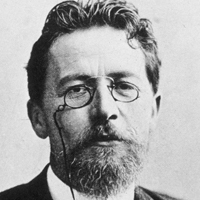
Anton P. Chekhov(1860-1904)
Chekhov's first book of stories (1886) was a success, and gradually he became a full-time writer. The author's refusal to join the ranks of social critics arouse the wrath of liberal and radical intelligentsia and he was criticized for dealing with serious social and moral questions, but avoiding giving answers. However, he was defended by such leading writers as Leo Tolstoy and Nikolai Leskov. "I'm not a liberal, or a conservative, or a gradualist, or a monk, or an indifferentist. I should like to be a free artist and that's all..." Chekhov said in 1888.
Chekhov was awarded the Pushkin Prize in 1888. The next year he was elected a member of the Society of Lovers of Russian Literature. In 1900 he became a member of the Academy of Sciences in St. Petersburg, but resigned his post two years later as a protest against the cancellation by the authorities of Gorky's election to the Academy. Later, in 1900, Gorky wrote to him: "After any of your stories, however insignificant, everything appears crude, as if not written by a pen, but by a cudgel."
Anton Chekhov is a writer of more than three hundred short stories. As a short story writer Chekhov was phenomenally fast – he could compose a little sketch or a joke while just visiting at a newspaper office. During his career, he produced several hundred tales. Palata No. 6 (1892, Ward Number Six) is Chekhov's classical tale of the abuse of psychiatry. He wrote plays also. His first theatrical works were not successful. His early failure in the field of theatre encouraged him to produce more successful plays. Some of his most successful plays are The Seagull (1896) Uncle Vanya (1897) Three Sisters (1901) and The Cherry Orchard (1903). These famous plays of Chekhov essentially reshaped modern drama. The Cherry Orchard (1904), reflected the larger developments in the Russian society. Madame Ranevskaya returns to her estate and finds out that the family house, together with the adjoining orchard, is to be auctioned. Her brother Gayev is too impractical to help in the crisis. The businessman Lopakhin purchases the estate and the orchard are demolished. "Everything on earth must come to an end..."
The kind of style Chekhov developed in these brilliant plays is described as a subtle blend of naturalism and symbolism. The surface of Chekhov's plays is so lifelike that at times one feels his purposes are submerged, and to an extent that is true, the technique, which Chekhov uses in most of his successful plays is the subtext. The subtext is the favorite technique of Anton Chekhov. He is even said to be the master of the subtext. In this technique the surface of the dialogue seems innocuous or meandering but deeper meanings are implied. Madame Ranevskaya's musings about her childhood in act I of The Cherry Orchard contrasts with the purposeful dialogue of Lopakhin. Her long speeches in act III talking about the "Millstone" she loves in Paris are also meanderings, but they reveal an idealistic character doomed to suffer at the hands of a new generation of realists who have no time for her ramblings and sentimentalism.
Because Chekhov's subtexts are always present to read his work requires close attention. One must constantly probe, analyze, and ask what is implied by what is being said. Chekhov resists explaining his plays by having key characters give key thematic speeches. Instead the meaning builds slowly. Our understanding of what a situation or circumstance finally means will change as we read, and as we gather more understanding of the subtleties veiled by surfaces. Chekhov's style is remarkable for its clarity; its surface is direct, simple and effective. Even his short stories have a clear dramatic center, and the characters he chose to observe are exceptionally modern in that they are not heroes, not villains. The dramatic concept of a larger than life Oedipus or of Hamlet's devilish Claudius is nowhere to be seen in his work Chekhov's characters are limited, recognizable, and in many ways completely ordinary.
Chekhov's genius was showing such character's ambitions, pain, and successes. He was quite aware of important social changes taking place in Russia. The old aristocratic classes, who once owned serfs, were being reduced to a genteel impoverished, while the children of former slaves were beginning to succeed in business and real estate ventures. Since Chekhov's grandfather had been a serf who bought his freedom in 1841, it is likely that Chekhov was especially supportive of such social change. We see evidence of that in his best plays.
Today Chekhov's fame today rests primarily on his plays. He used ordinary conversations, pauses, non-communication, non-happening, incomplete thoughts, to reveal the truth behind trivial words and daily life. There is always a division between the outer appearance and the inner currents of thoughts and emotions. His characters belong often to the provincial middle class, petty aristocracy, or landowners of prerevolutionary Russia. They contemplate their unsatisfactory lives, immersed in nostalgia, unable to make decisions and help themselves when a crisis breaks out.
Chekhov died on July 14/15, 1904, in Badenweiler, Germany. He was buried in the cemetery of the Novodeviche Monastery in Moscow. Though, a celebrated figure by the Russian literary public at the time of his death, Chekhov remained rather unknown internationally until the years after World War I, until his works were translated into English.
Anton Chekhov Study Center
A Marriage Proposal (One Act Play)
Enemies (Short Story): Summary and Analysis
 |
bachelorandmaster.com |