Gerard Manley Hopkins - Biography and Works
Gerard Manley Hopkins was born in Essex. In 1863, he entered Oxford University. There, he experienced a spiritual crisis that led him to join the Roman Catholic Church in 1866. Hopkins entered the Jesuit order in 1868. He then stopped writing and burned the manuscripts of his poems. Hopkins returned to writing in 1875 after being encouraged by a Jesuit superior.
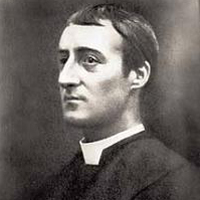
Gerard M. Hopkins (1844-1889)
He was ordained a priest in 1877. At the suggestion of a friend that he could write poems about the nature by appreciating God’s greatness, Hopkins started writing such poems; he felt poems about the beauty of culture could also be religious at the same time. He combined his artistic (and romantic) interests with his religious interests and explored both his faith and love of beauty in God’s wonderful nature.
Hopkins once tried to become a painter, and that seems to have left an impact in his poetry. Hopkins was a romantic poet till the age of 22, which he was influenced by a strong religious reawakening (of ritualistic Christianity) called the Oxford Movement. He became a Catholic Christian, and later he became a Jesuit priest (or, member of the Society of Jesus). Hopkins ranks as a major poet of Victorian England, though his work remained almost unknown until 1918, when it was first published. Hopkins wrote most of his poetry in sprung rhythm, which emphasizes the natural rhythms of speech.
He filled his verse with alliteration and unusual combinations of words. His poems, which are especially effective when read aloud, include the long and complex “The Wreck of the Deutschland.” The poem makes bold use of Hopkins’s “sprung rhythm” technique (whereby each foot has one stressed syllable followed by a varying number of unstressed), as do his best-known poems “The Windhover” and “Pied Beauty” both written in 1877. His work, collected in Poems (1918), was published posthumously by his friend Robert Bridges.
Hopkins experiments the new type of poetry different from his contemporary Victorian poets. His poetic practice was in some essential respects the reverse of Tennyson’s. Instead of using imagery in order to achieve an expansion outward into a generalized mood, he used it so as to refer continuously and cumulatively back to the poem until a total structure of meaning was contained in the poem, a meaning that exploded with immense force once it became known.
Hopkins’s endeavor was to achieve the unique and essential meaning of the experience he was embodying; ‘inscape’ (i.e. inner form of nature), the individual and distinctive design, was for him the true reality and the personality of the poem. His use of sprung rhythm and emotional pattern is unique. An almost Anglo-Saxon strength is given to the verse by the alliterative beat. His poems seek to unite passionate appreciation and dilated awareness of the beauty of nature with a deep religious sense of God’s presence and reality. The recharging of language, the vitalizing of rhythms, the counterpointing of colloquial and formal speech, the structuring of imagery into a complex totality of meaning are the characteristics of his poetry. The devotional feeling in mundane human activities is a significant aspect of Hopkins’s technique. His poetic aim consists in trying up of human and divine. His 'The Windhover' is one of the most remarkable poems in the use of imagery.
Hopkins’s oddities – his elisions, omission of relative pronouns, twisted word order, and so on- are part of his strength and individuality. He gives new meaning, new dignity and precision to worn words. But perhaps his greatest achievement was in breaking out to both the Victorian elegiac mode and of the Wordsworthian mode of nature poetry to achieve a fresh and original handling of personal sorrow and of feeling for nature.
Related Topics
God's Grandeur: Summary and Analysis
The Windhover: Summary and Analysis
Pied Beauty: Summary and Analysis
Spring and Fall: Summary and Analysis
 |
bachelorandmaster.com |