Henrik Ibsen - Biography and Works
Henrik (John) Ibsen (1828-1906) was born in Norway. He was born in a small Norwegian timber port of Skein. His ancestors were sea captains and businessmen while his father was rich merchant, dealing in Lumber. In his writings later on we find the recurrent theme of the sea. Three brothers and a sister were born after him, but Henrik was the only member of his family to show promise.
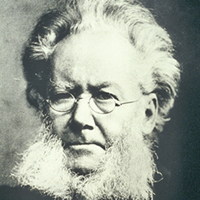
Henrik Ibsen (1828-1906)
When he was only eight years old his father's business failed and the family retired to a country house. When they lost their financial support, as a young boy Ibsen had to forsake all his friends with whom he ate and play. Since then Ibsen has experienced a bitter poverty during much of his youth and early manhood.
As a young boy Ibsen had shown his interest in the talent for art, but his poor family could not afford that, neither could they help him in studying medicine.
When Ibsen was only fifteen years old his father sent him to Grimstad, a small town south of Skein. During the three years living at Grimstad, he practiced as he deeply studied contemporary poetry and theology. He attracted many friends and gradually he became the center of a small circle of young men. He began writing poetry at the age of nineteen.
In order to prepare for the university, he learned Latin and studied Cicero. Since then he has been deeply interested in the character of Catiline, who was the agitator and revolutionary. He at the time wrote his first play Catiline, a blank verse tragedy when he was only twenty-two. This historical drama was published with the help of many of his enthusiastic friends, but it could not win success.
Since then Ibsen has spent six dark years in the hostile atmosphere of this provincial Norwegian village. The times were bitter and hard, however, he had set a little money hoping to join the University for further study. Then he left for the capital of Norway, where he enrolled in a ''student-factory'', a popular name given to an irregular school which coached students for the entrance examination of the university. Here Ibsen first met his lifelong rival and contemporary, Bjornstjerne Bjornson, who was to be known in the future along with Ibsen, as a national poet in Norway. But Ibsen failed to enter the university because he was found deficient in two subjects. His first play Cataline was also rejected by the Christianian Theatre however; his The Warrier's Barrow was accepted and performed three times in 1850. The play was set in Viking times. Now, he began to feel interested in the theatre.
Ibsen lived more than twenty years in Germany, but he made his home in Norway at the age of 63 and lived there until his death. At the age of 18 he had fathered an illegitimate with a servant girl. He wrote Pillars of Society in Germany, which is regarded as one of the great modern prose plays. He wrote A Doll's House in Italy, which established his international reputation. His Ghosts was published in 1881 which was rejected for the first time, though it was later produced in different parts of Europe. His An Enemy of the People is translated throughout the whole world. Other great works that have established Ibsen’s fame are The Wild Duck, The Lady from the Sea, Hedda Gabler, The Master Builder, etc. Ibsen died at the age of 78 in 1906.