Henry James - Biography and Works
Henry James (1843-1916), an American expatriate writer was born in New York City into a wealthy family. His father, Henry James Sr., was one of the best-known intellectuals in mid-nineteenth-century America, whose friends included Thoreau, Emerson and Hawthorne. In his youth James traveled back and forth between Europe and America.
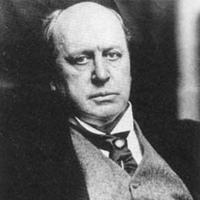
Henry James (1843-1916)
He studied with tutors in Geneva, London, Paris, Bologna and Bonn. At the age of nineteen he briefly attended Harvard Law School, but was more interested in literature than studying law.
James published his first short story, 'A Tragedy of Errors' two years later, and then devoted himself to literature. In 1866-69 and 1871-72 he was contributing to the Nation and The Atlantic Monthly. From an early age James had read the classics of English, American, French and German literature, and Russian classics in translation. His first novel, Watch and Ward (1871), appeared first serially in The Atlantic Monthly. James wrote it while he was traveling through Venice and Paris. Watch and Ward tells a story of a bachelor who adopts a twelve-year-old girl and plans to marry her.
After living in Paris, where James was contributor to the New York Tribune, he moved to England, living first in London and then in Rye, Sussex. "It is a real stroke of luck for a particular country that the capital of the human race happens to be British. Surely every other people would have it theirs if they could. Whether the English deserve to hold it any longer might be an interesting field of inquiry; but as they have not yet let it slip the writer of these lines professes without scruple that the arrangement is to his personal taste. For after all, if the sense of life is greatest there, it is a sense of the life of the people of our incomparable English speech." (From London, 1888) During his first years in Europe James wrote novels that portrayed Americans living abroad. James's years in England were uneventful. In 1905 he visited America for the first time in twenty-five year, and wrote 'Jolly Corner'. It was based on his observations of New York, but also a nightmare of a man, who is haunted by a doppelgänger.
Between 1906 and 1910 James revised many of his tales and novels for the so-called New York Edition of his complete works. It was published by Charles Scribner's Sons. His autobiography, A Small Boy and Others (1913) was continued in Notes of a Son and Brother (1914). The third volume, The Middle Years, appeared posthumously in 1917. The outbreak of World War I, was a shock for James and in 1915 he became a British citizen as a loyalty to his adopted country and in protest against the US's refusal to enter the war.
James suffered a stroke on December 2, 1915. He expected to die and exclaimed: "So this is it at last, the distinguished thing!" However, James died three months later in Rye on February 28, 1916. Two novels, The Ivory Tower and The Sense of the Past (1917), were left unfinished at his death.
Characteristic for James novels are understanding and sensitively drawn lady portraits; James himself was a homosexual, but sensitive to basic sexual differences and the fact that he was a male. His main themes were the innocence of the New World in conflict with corruption and wisdom of the Old. Among his masterpieces is Daisy Miller (1879), where the young and innocent American Daisy finds her values in conflict with European sophistication. In The Portrait of a Lady (1881) again a young American woman is fooled during her travels in Europe. James started to write the work in Florence in 1879 and continued with it in Venice. The definitive version appeared in 1908. "I had rooms on Riva Sciavoni, at the top of a house near the passage leading off to San Zaccaria; the waterside life, the wondrous lagoon spread before me, and the ceaseless human chatter of Venice came in at my windows, to which I seem to myself to have been constantly driven, in the fruitless fidget of composition, as if to see whether, out in the blue channel, the ship of some right suggestion, of some better phrase, of the next happy twist of my subject, the next true touch for my canvas, mightn't come into sight."
The protagonist is Isabel Archer, a penniless orphan. She goes to England to stay with her aunt and uncle, and their tubercular son, Ralph. Isabel inherits money and goes to Continent with Mrs. Touchett and Madame Merle. She turns down proposals of marriage from Casper Goodwood, and marries Gilbert Osmond, a middle-aged snobbish widower with a young daughter, Pansy. "He had a light, lean, rather languid-looking figure, and was apparently neither tall nor short. He was dressed as a man who takes little other trouble about it than to have no vulgar thing." Isabel discovers that Pansy is Madame Merle's daughter, it was Madame Merle's plot to marry Isabel to Osmond so that he, and Pansy can enjoy Isabel's wealth. Caspar Goodwood makes a last attempt to gain her, but she returns to Osmond and Pansy.
The Bostonians (1886), set in the era of the rising feminist movement, was based on Alphonse Daudet's novel L'Évangéliste. What Maisie Knew (1897) depicted a preadolescent young girl, who must choose between her parents and a motherly old governess. In The Wings of The Dove (1902) a heritage destroys the love of a young couple. James considered The Ambassadors (1903) his most "perfect" work of art. The novel depicts Lambert Strether's attempts to persuade Mrs Newsome's son Chad to return from Paris back to the United States. Strether's possibility to marry Mrs Newsome is dropped and he remains content in his role as a widower and observer.
James's most famous tales include 'The Turn of the Screw', written mostly in the form of a journal, was first published serially in Collier's Weekly, and then with another story in The Two Magics (1898).