Lady Gregory - Biography and Works
Isabella, Lady Gregory (1852-1932), popularly called Lady Gregory, is an Irish playwright and promoter of Irish drama. She founded the Irish Literary Theatre with William Butler Yeats in 1898. This became the Irish National Theatre Society in 1902 and led to the establishment of the Abbey Theatre in Dublin. Throughout her life she remained the chief organizer.
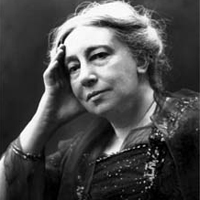
Lady Gregory (1852-1932)
Lady Gregory is an Irish dramatist. Ireland is the source of essential materials for her poems. The subject-matters of her dramas have not gone beyond the boundaries of Ireland. By the time Lady Gregory tried her pen in the field of playwriting Irish national drama made its appearance. The name of Lady Gregory can never be separated from this new mode of Irish national drama. She not only made a significant contribution to this kind of drama, but also became a pioneering spirit in this field. To propagate the sentiments of nationality and unity is the main thrust of Irish national theatre.
For the most part Lady Gregory taught herself at home. She was privately educated. It is doubtless true that Lady Gregory’s interest in developing a theatre in Dublin is initially nationalist in intention. Her entire pursuit for playwriting had been welcomed as an indirect way of preparing for home rule. Through artistic pursuits Lady Gregory sought to pave a political way for Home rule. To achieve this goal, she brought into prominence the Irish dramatic movement. In the accomplishment of her politically motivated artistic dream, Lady Gregory managed to solicit support from those who wished well of her, for those who visited well of her, from those who were in favor for home rule.
She has derived her themes from Irish history, and from her keen sense of character in daily life. In the creation of one-act play Lady Gregory is extremely excellent. Some of her famous one-act plays are tragic and comic as well. Spreading the News (1904), The Gaol Gate (1906) and The Rising of the Moon (1907) are classical examples of Lady Gregory’s plays. The distinct success of Gregory’s The Rising of the Moon is dependent upon her exceptional ear for dialogue. She captures the way people speak. She has managed to draw the characters of the sergeant and ballad singer, so as to gain our sympathies for both. In a remarkable economic fashion, she dramatizes the problem of politics in Ireland. Characterizing the two polarities and revealing some of the complexities that face anyone who tries to understand them. The use of local dialect in play is the distinguishing feature of Lady Gregory’s plays. The use of dialect in play not only remained limited in Lady Gregory’s hand, but passed into the hand of other playwrights. The widening influence of Lady Gregory touched John Millington Synge. Synge introduced the local dialect into his plays. American dramatist Eugene O’Neill had openly declared that he knew about the method of introducing local dialects in plays form Lady Gregory. From the remark of Eugene O’Neill we became pretty aware of the contributing effect of Lady Gregory’s dramatic craftsmanship.