Mark Twain - Biography and Works
Samuel Langhorne Clemens, who wrote under the pen name of Mark Twain, was born in Florida, Missouri, of a Virginian family. The family soon moved to Hannibal, Missouri, where Twain was brought up. At school, according to his own words, he "excelled only in spelling". After his father's death in 1847, Twain was apprenticed to a printer. He also started his career as a journalist by writing for the Hannibal Journal. Later Twain worked as a licensed Mississippi river-boat pilot (1857-61).
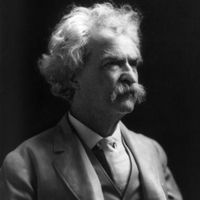
Mark Twain (1835-1910)
But this isn't the full story: he had also satirized an older writer, Isaiah Sellers, who called himself Mark Twain. In 1861 Twain served briefly as a confederate irregular. The Civil War put an end to the steamboat traffic, and during a period when Twain was out of work, he lived in a primitive cabin on Jackass Hill and tried his luck as a gold-miner. "I would have been more or less than human if I had not gone mad like the rest," he confessed. His famous pen name Twain adopted from the call ('Mark twain!' – meaning of the mark of two fathoms) used when sounding river shallows.
Twain moved to Virginia City, where he edited two years Territorial Enterprise. On February 3, 1863, 'Mark Twain' was born when he signed a humorous travel account with that pseudonym. In 1864 Twain left for California, where worked in San Francisco as a reporter. After hearing a story about a frog, Twain made an entry in his notebook: "Coleman with his jumping frog – bet a stranger $50. – Stranger had no frog and C. got him one: – In the meantime stranger filled C's frog full of shot and he couldn't jump. The stranger's frog won." From these lines he developed 'Jim Smiley and his Jumping Frog' which was published in The Saturday Press of New York on the 18th of November in 1865. It was reprinted all over the country and became the foundation stone of The Celebrated Jumping Frog of Calaveras County, and Other Sketches (1867). This work marked the beginning of Twain's literary career.
In 1866 Twain visited Hawaii as a correspondent for The Sacramento Union, publishing letters on his trip. He then set out world tour, travelling in France and Italy. His experiences Twain recorded in The Innocents Abroad (1869). The work, which gained him wide popularity, poked fun at both American and European prejudices and manners. Throughout his life, Twain frequently returned to travel writing – many of his finest novels, such as The Adventures of Tom Sawyer (1876), dealt with journeys and escapes into freedom.
The success of The Innocents Abroad gave Twain enough financial security to marry Olivia Langdon in 1870, after writing about 189 love letters during his courtship. William Dean Howells praised the author in The Atlantic Monthly, and Twain thanked him by saying: "When I read that review of yours, I felt like the woman who was so glad her baby had come white".
Olivia, Twain's beloved Livy, served and protected her husband devotedly. They moved to Hartford, where the family remained, with occasional trips abroad, until 1891. Twain continued to lecture in the United States and England. Between 1876 and 1884 he published several masterpieces. Tom Sawyer was originally intended for adults. Twain had abandoned the work in 1874, but returned to it in the following summer and even then was undecided if he were writing a book for adults or for young readers. Eventually he declared that it was "professedly and confessedly a boy's and girl's book". The Prince and the Pauper (1881) was about Edward VI of England and a little pauper who change places. The book was dedicated "to those good-mannered and agreeable children, Susie and Clara Clemens." Life on the Mississippi (1883) contained an attack on the influence of Sir Walter Scott, whose romanticism have caused according to Twain 'measureless harm' to progressive ideas. From the very beginning of his journalistic career, Twain made fun with the novel and its tradition. Although Twain enjoyed magnificent popularity as a novelist, he believed that he lacked the analytical sensibility necessary to the novelist's art.
Huckleberry Finn (1884), an American Odysseus, was first considered adult fiction. Huck, who could not possibly write a story, tells us the story: "You don't know about me without you have read a book by the name of The Adventures of Tom Sawyer, but that ain't no matter. That book was made by Mr. Mark Twain and he told the truth, mainly." Both Tom Sawyer and Huckleberry Finn stand high on the list of eminent writers like Stevenson, Dickens, and Saroyan who honestly depicted young people. Huck's debate whether or not he will turn in Jim, an escaped slave and a friend, probed the racial tensions of the national conscience. Later Twain wrote in The Man That Corrupted Hadleyburg (1900): "I have no race prejudices... All that I care to know is that a man is a human being - that is enough for me; he can't be any worse".
One of Twain's major achievements is the way he narrates Huckleberry Finn, following the twists and turns of ordinary speech, his native Missouri dialect. Shelley Fisher Fishkin has noted in Was Huck Black? (1993) that the book drew upon a vernacular formed by black voices as well as white. The model for Huck Finn's voice, according to Fishkin, was a black child instead of a white one. The character of Huck was based on a boy named Tom Blankenship, Twain's boyhood friend.