Mary Wollstonecraft Shelley - Biography and Works
Mary Wollstonecraft Shelley (1797-1851) was born in London. Her mother, Mary Wollstonecraft, was one of the first feminists, the author of A Vindication of the Rights of Woman (1792), and the novel The Wrongs of Woman, in which she wrote: "We cannot, without depraving our minds, endeavor to please a lover or husband, but in proportion as he pleases us.
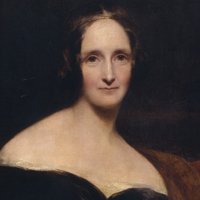
Mary Wollstonecraft Shelley
Mary Shelley's father was the writer and political journalist William Godwin, who became famous with his work An Enquiry Concerning Political Justice (1793). Godwin had revolutionary attitudes to most social institutions, including marriage. In feminism he found an "amazonian" element. Among his other books is Things as They Are, or The Adventures of Caleb Williams (1794). In her childhood Mary Shelley was left to educate herself amongst her father's intellectual circle, the critic Hazlitt, the essayist Lamb, the poet Coleridge and Percy Bysshe Shelley, who came into Godwin's circle in 1812.
Godwin took a second in 1801, but Mary never learned to like her. In 1812 Godwin sent her to live in Dundee. Mary published her first poem at the age of ten. At the age of 16 she ran away to France and Switzerland with Shelley; they had met at the end of 1812. Percy and Mary married in 1816 - Shelley's wife Harriet had committed suicide by drowning. Their first child, a daughter, died in Venice, Italy, a few years later. In History of Six Weeks Tour (1817) the Shelleys jointly recorded their life. Thereafter they returned to England and Mary gave birth to a son, William.
The story of Frankenstein started on summer in 1816, when Mary joined with Percy Shelley and Claire Clairmont near Geneva Lord Byron. She took a challenge, set by Lord Byron, to write a ghost story. With her husband's encouragement, she completed the novel within a year. At the Villa Diodati she had been a "silent listener" of her husband and Byron, who discussed about galvanism. At Eton College Shelley had become interested in Luigi Calvani's experiments with electric shocks to make dead frogs' muscles twitch. It is possible that his teacher, James Lind, had demonstrated the technique to Shelley. Byron and Shelley talked Dr. Darwin's experiments with a piece of vermicelli. In her 'Introduction' to the 1831 edition Mary revealed that she got the story from a dream, in which she saw "the hideous phantasm of a man stretched out, and then, on the working of some powerful engine, show signs of life, and stir with an uneasy, half vital motion."
The first edition of the book had an unsigned preface by Percy Shelley. Many thought that it is also his novel, disbelieving that only 19-year-old woman could write such horror story. However, when the book was published in 1818, it became a huge success, although it received mixed reviews.
None of Shelley's novels from this period matched the power of her first legendary achievement. Her later works include Lodore (1835) and Faulkner (1937), both romantic pot-boilers, and unfinished Mathide (1819, published 1959), which draws on her relations with Godwin and Shelley. Valperga (1823) is a romance set in the 14th-century, and The Last Man (1826), set in the 21st century republican England, depicts the end of human civilization. Its second part describes the gradual destruction of the human race by plague. The narrator is Lionel Verney, the last man of the title, living amidst the ruins of Rome. Feminist critics have paid attention to its fantasy of the total corrosion of patriarchal order.