Nathaniel Hawthorne - Biography and Works
Nathaniel Hawthorne (1804-1864) was born in Salem, Massachusetts. His father, was a sea captain and descendent of John Hawthorne, one of the judges in the Salem witchcraft trials of 1692. He died when the young Nathaniel was four years old. Elizabeth Clarke Manning Hawthorne, his mother, withdrew to a life of seclusion, which she maintained till her death. From Salem the family moved to Maine, where Hawthorne was educated at the Bowdoin College (1821-24).
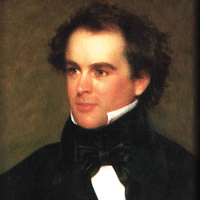
Nathaniel Hawthorne
In the school among his friends were Longfellow and Franklin Pierce, who became the 14th president of the U.S. Between the years 1825 and 1836, Hawthorne worked as a writer and contributor to periodicals. Among Hawthorne's friends was John L. O'Sullivan, whose magazine the Democratic Review published two dozen stories by him.
According to an anecdote, Nathaniel Hawthorne burned his first short-story collection, Seven Tales of My Native Land, after publishers rejected it. Nathaniel Hawthorne's first novel, Fanshawe (1828), appeared anonymously at his own expense. The work was based on his college life. It did not receive much attention and the author burned the unsold copies. However, the book initiated a friendship between Nathaniel Hawthorne and the publisher Samuel Goodrich. He edited in 1836 the American Magazine of Useful and Entertaining Knowledge in Boston.
Hawthorne's second, expanded edition of Twice-Told Tales (1837), was praised by Edgar Allan Poe in Graham's Magazine. "We know of few compositions which the critic can more honestly commend that these Twice-Told Tales," Poe stated. "As Americans, we feel proud of the book." Among Hawthorne's most widely anthologized stories are 'Young Goodman Brown' (1835), originally published in the New-England Magazine, 'The Birthmark (1843), published in Pioneer, and 'Rappacini's Daughter' (1844), which first appeared in Democratic Review, and was collected in Mosses From An Old Manse (1846). 'Young Goodman Brown', also included in this collection, is an allegorical tale, in which Hawthorne touches many of his favorite themes, such as hypocrisy, witchcraft, the Puritan guilt, and the sins of the fathers.
In 1842 Hawthorne became friends with the Transcendentalists in Concord, Ralph Waldo Emerson and Henry David Thoreau, who also drew on the Puritan legacy. However, generally he did not have much confidence in intellectuals and artists, and eventually he had to admit, that "the treasure of intellectual gold" did not provide food for his family. In 1842 Hawthorne married Sophia Peabody, an active participant in the Transcendentalist movement. Only the bride's family attended the wedding. Hawthorne settled with Sophia first in Concord, but a growing family and mounting debts compelled their return to Salem. Hawthorne was unable to earn a living as a writer and in 1846 he was appointed surveyor of the Port of Salem.
The Scarlet Letter was a critical and popular success. The illicit love affair of Hester Prynne with the Reverend Arthur Dimmesdale and the birth of their child Pearl, takes place before the book opens. In Puritan New England, Hester, the mother of an illegitimate child, wears the scarlet A (for adulteress, named in the book by this initial) for years rather than reveal that her lover was the saintly young village minister. Her husband, Roger Chillingworth, proceeds to torment the guilt stricken man, who confesses his adultery before dying in Hester's arms. Hester plans to take her daughter Pearl to Europe to begin a new life. Toward the end of the dark romance, Hawthorne wrote: "Be true! Be true! Show freely to the world, if not your worst, yet some trait whereby the worst may be inferred!" Hester Prynne has been seen as a pioneer feminist in the line from Anne Hutchinson to Margaret Fuller, a classic nurturer, a sexually autonomous woman, and an American equivalent of Anna Karenina. The influence of the novel is apparent in Henry James's The Portrait of a Lady (1881), in Kate Chopin's The Awakening (1899), and in William Faulkner's As I Lay Dying (1930). Hawthorne's daughter Una, christened after Spenser's heroine in The Faerie Queene, served as the model for Pearl.
Hawthorne was one of the first American writers to explore the hidden motivations of his characters. Among his allegorical stories is 'The Artist of the Beautiful' (1844) in which his protagonist creates an insect, perhaps a steam-driven butterfly. A girl he admires asks whether he made it, and he answers: "Wherefore ask who created it, so it be beautiful?" Eventually the insect is killed by an unfeeling child. Of his own workroom Hawthorne said: "This deserves to be called a haunted chamber, for thousands and thousands of visions have appeared to me in it."
"The Custom-House" sketch, prefatory to The Scarlet Letter, was based partly on his experiences in Salem. The novel, which appeared in 1850, told a story of the earliest victims of Puritan obsession and spiritual intolerance. Again, the central theme is the effects of guilt and anxiety. Hawthorne's picture of the sin-obsessed Puritans has subsequently been criticized-they were less extreme than presented in the works of Hawthorne, Arthur Miller, Steven King, and many others. The House of the Seven Gables was published the following year. The story is based on the legend of a curse pronounced on Hawthorne's own family by a woman, who was condemned to death during the Salem witchcraft trials. The curse is mirrored in the decay of the Pyncheons' seven-gabled mansion. Finally the descendant of the killed woman marries a young niece of the family, and the hereditary sin ends.
Hawthorne died on May 19, 1864, in Plymouth, N.H. on a trip to the mountains with his friend Franklin Pierce. After his death, Sophia Hawthorne edited and published his notebooks. Modern editions of these works include many of the sections which she cut out or altered. The author's son Julian was convicted in 1912 of defrauding the public.