Jerome David Salinger - Biography and Works
Jerome David Salinger (1919-2010) was born as a son of a well to do family. His father was a Jewish importer of cheese and mother was Scotch-Irish. He was grown up in the fashionable apartment district of Manhattan, New York. In his childhood the young Jerome David Salinger was called Sonny. He was sent to Valley Forge Military Academy in 1934 and in 1936 he graduated from there.
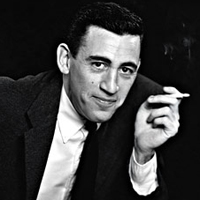
Jerome David Salinger
He studied at Ursinus College and New York University from 1937 to 1938. He was in deep love with O'Neill that he wrote her letters almost daily. He was shocked when she married Charles Chaplin, who was much older than she. In 1939 Salinger took a class in short story writing at Columbia University under Whit Burnett, who was a founder-editor of the Story Magazine. During W.W.II he was recruited into the infantry (a soldier who fight on foot without mounting on anything) and was involved in the invasion of Normandy.
After returning to civilian life from the war, he starts writing stories influenced by the war. Salinger's early short stories appeared in magazines such as Story, where his first story was published in 1940, Saturday Evening Post and Esquire, and then in the New Yorker, which published almost all of his later texts. He is especially famous for his dealing with the problems of adolescents, their alienation from family and society, and their emotional instability.
In 1948 'A Perfect Day for Bananafish' appeared, which introduced a character, Seymour Glass, who commits suicide. It was the introduction of the Glass family, whose stories would continue to form the main body of his writing. Twenty stories were published in Collier's, Saturday Evening Post, Esquire, Good Housekeeping, Cosmopolitan, and the New Yorker between 1941 and 1948. In 1974, The Complete Uncompleted Stories of J. D. Salinger (2 vols.) appeared in pirated form. Many of them reflect Salinger's own service and experience in the army. Later Salinger adopted Hindu-Buddhist inspirations. He became a passionate devotee of The Gospels of Sri Ramakrishna, a study of Hindu theology, which was translated into English by Swami Nikhilananda and Joseph Campbell.
At the age of 31, Salinger's first novel, The Catcher in the Rye, became immediately a Book-of-the-Month Club selection and won huge international acclaim. This publication provides him a major place in American fiction writing and his novel becomes a landmark in the American literature. It sells still some 250, 000 copies annually. Salinger did not do much to help publicity, and asked that his photograph should not be used in connection with the book. Later he has turned down the requests from many people for movie adaptations of the book.
In the 1960s, Salinger nearly stopped writing and publishing. He suddenly disappeared from the public and shifted to his rural home in New Hampshire. He even did not want to appear in interviews. In an interview that he allowed in 1970s, Salinger states that he had not given up from the writing, in fact, he mentioned that he continued to write but rejected to publish. For him publication of his writings is like an 'invasion of his privacy'.