Sophocles - Biography and Works
Sophocles was one of the three great tragic dramatists of ancient Athens, the other two being Aeschylus and Euripides. Unlike his younger contemporary, the often-misunderstood Euripides, Sophocles had the fortune of being revered for his genius during his own lifetime.
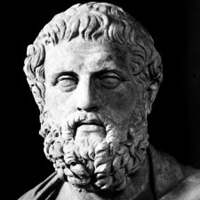
Sophocles
He lived to the ripe old age of ninety, and his life coincided with the great golden age of the city-state of Athens. Sophocles came from a stable, well-to-do family, and from the beginning, it seemed that he was blessed in every way. Handsome, wealthy, and well-educated, Sophocles lived and died as one of Athens' most beloved citizens. In the annual dramatic competitions organized by the state, Sophocles won first prize about 20 times.
Sophocles introduced several important advances into Greek theater. He increased the number of actors from two to three, thus lessening the influence of the chorus and making possible greater complication of the plot and the more effective portrayal of character, by contrast and juxtaposition; and he changed the Aeschylean fashion of composing plays in groups of three (trilogy). Aeschylus, for example, had used three tragedies to tell a single story, each of them part of a central myth or theme. Sophocles chose to make each tragedy a complete entity in itself and made each play an independent psychological and dramatic unity. He had to pack all of his action into the shorter form, and this clearly offered greater dramatic possibilities. His richly developed characters often exhibit tragic flaws that ironically support their unwelcome destinies. Sophocles improved stage scenery, reduced the importance of the chorus, and, most significantly, added a third speaking actor to the traditional two. Of the three tragedians, he has what is arguably the best sense of drama and pacing. His plays are cleanly made, tightly constructed and filled with beautiful poetry. In many ways, he was a conservative man, a firm believer in Athenian religion and Athenian government.
Sophocles' pursuit of creativity ranged from his youth to his old age. His plays written in the later part of his life are tremendously outstanding. It has been assumed that Sophocles wrote more than a hundred twenty plays, of which we know the titles of 118. Of this huge output of plays only seven complete tragedies survive: Antigone, Oedipus Rex (sometimes also called Oedipus Tyrannos), Oedipus at Colonos, Ajax, Electra, The Women of Trachis, and Philoctetes.
Apart from being an excellent tragedian Sophocles was a statesman as well. In many cases his career as a statesman and tragedian overlapped to the point of confusion. Whether Sophocles enjoyed the status of being a statesman or not we don't know. But what we know confidently is that Sophocles might have enjoyed the respect and regard from the Athenian Society. As a man of action it was necessary for Sophocles to be sociable. By the same token, he was religious. He was well-acquainted with the religious cults. "Antigone" (441 B.C.) is the kind of play, which is evocative of Sophocles' deepest obsessions with the then political concerns.