William Faulkner - Biography and Works
William Faulkner (1897-1962) was as the first son of Murray Charles Faulkner and Maud Faulkner in New Albany, Mississippi. At the age of thirteen he began writing poetry. He did not complete his graduation, he dropped out the school in 1925 and started working in Grandfather's bank. During First World War, he joined with the Royal Canadian Air Force but he never got the chance to see the war.
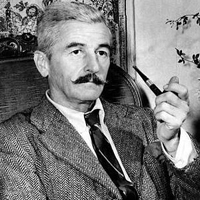
William Faulkner (1897-1962)
After the end of the war, he studied literature at the University of Mississippi. There he composed some poems and drew some humorous cartoons for the magazine of the university.
Faulkner's early works were dominantly influenced by Keats, Tennyson and Swinburne. His first poetic collection was The Marble Faun (1924) which is full of fine pastoral poems. Privately published poetry collection The Marble Faun was not a huge success. Next year he went to New Orleans and worked as a journalist. During his stay there he met with American story writer Sherwood Anderson. With his great help, Faulkner became success to publish his first novel Soldier's Play (1926) which is about a physically and psychologically wounded soldier in WW I. Anderson also motivated him to write further about the people he knew and the places he had been to.
When he came back to America, he started writing about the ancestors, Native Americans, blacks, hermits and poor whites. His fifteen novels out of nineteen novels were set in an imaginary county named Yoknapatawpha. His first novel which is set in this imaginary county was Sartoris (1929). The same year saw the publication of another novel, The Sound and the Fury, a story of the tragic end of the Compson family. In this novel, he used the four different narrative perspectives with fragmented plot. This is the beginning of his new technique that he would use in his rest of the novels. In the same year he got married to his childhood beloved Estelle Oldham. With the success as a novelist, he was offered a job as a script writer in Hollywood. He did this rewarding job for some years.
He created an imaginary county in North Mississippi called Yoknopatawpha of which the county seat is Jefferson. From 1925 until his death in 1962 his major novels are based on this fictional world, the world of Yoknapatawpha. His fifteen novels that are set in Yoknapatawpha are generally known as Yoknapatawpha novels. His mythical Yoknapatawpha County became one of the most famous mini worlds in twentieth century literature. These novels were written at the time in America when the effects of the economic depression were at the peak. Racism, class division, family as both life force and a curse, are the recurring themes along with recurring characters and places. Faulkner used various writing styles. The narrative varies from the traditional storytelling Light in August to a series of snapshots As I Lay Dying or collage The Sound and the Fury.
Faulkner is a prominent figure of southern fiction who followed modernist techniques, but became a rationalist in his writing. Faulkner's major issue is the tension between myth and history. Faulkner mixes the mythical tradition and ceremonial world which is the underlying subject of Faulkner's work. Faulkner novels are divided into first and second cycles. The first cycle of Yokhapatawpha novels includes stories, The Sound and the Fury, As I Lay Dying, Sanctuary, High in August and Absalom, Absalom. In these novels the major issue is the tension between myth and history. Sartoris is the first novel of Faulkner and the foundation of the Yoknapatawpha County on which the writer established most of his regionalist vision. This novel created background for Faulkner's further writing, presenting an image of Colonel John as the protection for Sartoris/ Yoknapatawpha. Similarly the second cycle of Yoknapatawpha novels includes Intrudes in the Dust, Requiem for a Nun, The Town, The Mansion and The Rivers. In these novels, the major issue is to construct a myth of man, which transcendent the history of man's condition. However the second cycle of Yoknapatwpha novels was not as impressive as the novels of the first. Besides, there is also a non –Yoknapatawpha novel of Faulkner written in 1954 - A Fable. This novel is also a mixture of mythical tradition and ceremonial world. But this novel for which Faulkner spent ten long years is the largest non - Yoknapatawpha work counted as his one genuine failure. However, from 1950 to 1975 in the post-world war age, William Faulkner is among three main figures that stand out among the southern novelists and the remaining two are Robert Penn Warren and Eudora Welty.