William Stafford - Biography and Works
William Stafford was born in the U.S.A in 1914. The eldest of three children, Stafford grew up with an appreciation for nature and books. During the Depression the family moved from town to town as Earl Stafford searched for jobs. William helped to support the family also, by delivering papers, working in the sugar beet fields, raising vegetables, and as an electrician's mate.
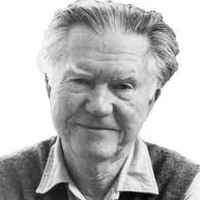
William Stafford (1914-1993)
In 1933 Stafford graduated from high school in Liberal, Kansas, and attended Garden City and El Dorado junior colleges, graduating from the University of Kansas in 1937. In 1939 Stafford enrolled at the University of Wisconsin to begin graduate studies in Economics, but by the next year he had returned to Kansas to earn his master's degree in English. Following the war Stafford taught one year at a high school, spent a year working for relief organization Church World Service, and finished his master's degree at the University of Kansas in 1947. His master's thesis, memoirs of his time spent as a conscientious objector, was published as a book of prose, Down in My Heart (Brethren Publishing House, 1947).
In 1944 while in California Stafford met and married Dorothy Frantz, the daughter of a minister of the Church of the Brethren. He took a doctorate at the University of Iowa. His first book was not published until 1959 (The Poems), when he was forty-five, but he has published a great deal during the ensuing years (Traveling Though the Dark 1962, The Rescued Year 1966, Temporary Facts 1970, In the Clock of Reason, 1973, Things That Happen When There Aren’t Any People 1980, Listening Deep 1984, Stones, Storms, and Strangers 1984 Wyoming 1985). His poems mostly have a non-urban locale. His other works include Down in My Heart (1947, rev. 1985), You Must Revise Your Life (1986).
Stafford's poems are often deceptively simple. Like Robert Frost's, however, they reveal a distinctive and complex vision upon closer examination. Among his best-known books are The Rescued Year (1966), Stories That Could Be True: New and Collected Poems (1977), Writing the Australian Crawl: Views on the Writer's Vocation (1978), and An Oregon Message (1987).