Economic Doctrine in Defoe's Robinson Crusoe
Although on the surface, it seems that Robinson Crusoe is largely novel of travel and adventure, in fact it is not so. Economic mentality has a vital role in Robinson Crusoe. According to Karl Marx, the protagonist in this novel proves himself to be a potential capitalist.
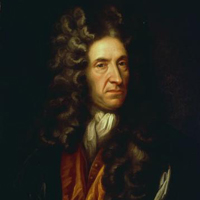
Daniel Defoe
But it is the critic Ian Watt, who offers a most stimulating and illuminating interpretation of this novel from the economic point of view. This critic relates Crusoe’s predicament on the desolate island to the rise of bourgeois individualism. In fact, this critic holds the view that almost all the principal characters created by Defoe in his novels are embodiments of economic individualism. These characters are Robinson Crusoe, Captain Singleton, Colonel Jacque, Moll Flanders and Roxana. All these protagonists pursue money, and they pursue it very methodically, according to the profit and loss book-keeping which is a distinctive technical feature of modern capitalism. The protagonists created by Defore have no need to learn this technique; they all have it in their blood. And they keep us informed of their stocks of money and commodities more than any other characters in fiction. As for Crusoe, his book keeping conscience establishes an effective priority over his other thoughts and emotions.
Crusoe shows himself to be a symbol of the processes connected with the rise of economic individualism. The economic motive logically involves a reduction in the importance of other modes of thought, feeling, and action. The economic motive becomes so important that such relationships as the family, the guide, the village, and the sense of nationhood are all weakened by it. In Defoe’s novel the protagonists either have no family or leave the family at an early age never to return to it. Crusoe does have his parents with whom he lives, but he leaves them from an economic motive, showing himself to be the homo economicus, wanting to improve the economic condition.
At the same time the argument between his parents and himself at the beginning is a debate not about religion or about filial duty, but about his economic circumstances. Both sides in this debate regard the economic argument as the most important. And, of course, Crusoe actually gains by his original sin, and becomes richer than his father was. Crusoe’s original sin is really the dynamic tendency of capitalism itself. The tendency of capitalism is never merely to maintain the status quo, but to improve upon it continuously. Leaving home and trying to raise oneself economically is a vital feature of the individualistic pattern of life.
Crusoe’s chief motive in traveling is profit; he doesn’t mind going to the remotest part of the world in quest of profit. He is a commercial traveler. Life is not only the economy, but at another aspect like love, sex, family, friendship all is needed in the common life of anybody. But if we analyze Crusoe from that aspect, on the Island, Crusoe hardly ever mentions, or thinks of women, or sexual desires, etc. because all these aspects of life’s core, overshadowed by the economic motive of Cruose. When ultimately he returns to civilization, sex is still strictly subordinated by him to the business.
The same devaluation of non-economic factors can be seen in Crusoe’s other relationships. In fact, he treats all relationships in terms of their commodity value. The clearest case is that of Xury, the Moorish boy, who helped him to escape from slavery and who had even offered to sacrifice his life for Cruose’s sake. Crusoe very properly resolves to love Xury always and to make a great man of him. But eventually he sells that boy to the Portuguese sea-captain for a small amount of money.
Crusoe’s relations with his man Friday are similarly selfish. He does not ask the man’s name, but gives him a name. Even while teaching him the English language, Crusoe contents himself with giving the man the minimum possible instruction because Crusoe is a strict utilitarian. “I likewise taught him to say yes and no”. Crusoe tells us; and Friday still speaks unsatisfactory and incorrect English at the end of his long association with Crusoe. It is evident, then, that Crusoe does not have any real understanding of the human instinct for friendship and for an emotional or sentimental attachment to persons. Man is regarded by Crusoe purely as an economic being; and Crusoe himself is one such person.
Another economic lesson from Crusoe’s adventure is that the labor and invention create useful things and carries on at the highest point of success. He succeeds in creating capital. He is laborious person and does not content with what nature provides him with. His life in the Island involves constant moving, sweating, toiling and racking his brains to find still more labourios occupations.
The value of money, imports and exports, labor, devotion, all are forcefully presented in the novel. Crusoe’s happiness has been presented at the point when he is economically prosperous at the end.
In short, all the data available to us shows that the novel Robinson Crusoe is a plea for the advancement and promotion of the concept of economic individualism and the resultant capitalism. The critic Arnold Kettle makes a similar approach to Robinson Crusoe, According to him, the novel is in one sense a story in praise of the bourgeois virtues of individualism and private enterprise. So the treatment of economic doctrine is more important than that the adventure of Crusoe in Defore’s novel.
In Defoe's novel the protagonist either has no family or leaves the family at an early age never to return to it. Crusoe does have his parents with whom he lives, but he leaves them from an economic motive, wanting to improve his economic condition. The argument between his parents and Crusoe at the beginning is a debate not about religion or about filial (parental) duty, but about his economic circumstances. Both sides in this debate regard the economic argument as the most important. And, of course, Crusoe has actually gained by his original sin and becomes richer than his father was.
The tendency of capitalism is never merely to maintain the status quo but to improve upon it continuously. So does Crusoe too. Leaving home and trying to raise oneself economically is a vital feature of Crusoe's pattern of life. Crusoe never shows any particular attachment of a sentimental kind to his country.
Crusoe is not a mere foot loss adventure. He travels like his non- attachment to family and to the nation, are an extreme case of tendency which is normal in modern society as a whole because, by making the pursuit of gain a primary motive, economic individualism has considerably increased the mobility of the individual.
Crusoe's chief motive in traveling is profit; he doesn't mind going to the remotest part of the world in quest of profit. He is a commercial traveler. Life is not only the economy but at another aspect like love, sex, family, friendship all is needed in the common life of anybody. But if we analyze Crusoe from that aspect, on his Island, Crusoe hardly ever mentions, or thinks of women, or sexual desires etc. because all these aspects of life's core, overshadowed by the economic motive of Crusoe. When ultimately he returns to civilization, sex is still strictly subordinated by him to the business. Another economic lesson from Crusoe's adventure is that the labor and invention create useful things and carries on at the highest point of success. He succeeds in creating capital. He is laborious person and does not content with what nature provides him with. His life in the Island involves constant moving, sweating, toiling and racking his brains to find still more laborious occupations.
The value of money, imports and exports, labor, devotion all are forcefully presented in the novel. Crusoe's happiness has been presented at the point when he is economically prosperous at the end. So the treatment of economic doctrine is more important than that the adventure of Crusoe in Defoe's novel.