|
|
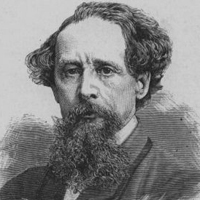
Charles
Dickens
Charles Dickens was born in Landport,
Hampshire, during the new industrial
age, which gave birth to theories of
Karl Marx. Dickens's father was a clerk
in the navy pay office. He was well
paid but often ended in financial troubles.
In 1814 Dickens moved to London, and
then to Chatham, where he received some
education. The schoolmaster William
Giles gave special attention to Dickens,
who made rapid progress. In 1824, at
the age of 12, Dickens was sent to work
for some months at a blacking factory,
Hungerford Market, London, while his
father John was in Marshalea debtor's
prison.
|
|
|
A
Christmas Carol (1843)
is one of Dickens's most loved
works, which has been adapted
into screen a number of times.
The character of Ebenezer
Scrooge, the "squeezing,
wrenching, grasping, scraping,
clutching" miser, has
attracted such actors as Seymour
Hicks, Albert Finney, Michael
Caine, George C. Scott and
Alastair Sim. In a pornography
version from 1975 Mary Stewart
was "Carol Screwge".
Historical subjects did not
much interest Dickens. Barnaby
Rudge (1841), set at
the time of the 'No Popery'
riots of 1780, and A Tale
of Two Cities (1859)
are exceptions.
|
A Tale of Two Cities was set
in the years of the French Revolution.
The plot circles around the look-alikes
Charles Darnay, a nephews of a marquis,
and Sydney Carton, a lawyer, who both
love the same woman, Lucy.
Among Dickens's
later works is David Copperfield
(1849-50), where he used his own personal
experiences of work in a factory. David's
widowed mother marries the tyrannical
Mr. Murdstone. David becomes friends
with Mr. Micawber and his family. "I
went in, and found there a stoutish,
middle-aged person, in a brown surtout
and black tights and shoes, with no
more hair upon his head (which was a
large one, and very shining) than there
is upon an egg, and with a very extensive
face, which he turned full upon me.
His clothes were shabby, but he had
an imposing short-collar on." Dora,
David's first wife, dies and he marries
Agnes. He pursues his career as a journalist
and later as a novelist.
Bleak
House (1853) belongs to
Dickens's greatest works of social social
criticism. The novel is built around
a lawsuit, the classic case of Jarndyce
and Jarndyce, which affects all who
come into contact with it. Much of the
story is narrated in the first person
by a young woman, Esther Summerson,
the illegitimate daughter of the proud
Lady Dedlock and Captain Hawdon. The
character of Harold Skimpole, an irresponsinbe
and lecherous idler, is said to be based
on the poet and journalist Leigh Hunt.
Great
Expectations (1860-61)
began as a serialized publication in
Dickens's periodical All
the Year Round on December
1, 1860. The story of Pip (Philip Pirrip)
was among Tolstoy's and Dostoyevsky's
favorite novels. G.K. Chesterton wrote
that it has "a quality of serene
irony and even sadness," which
according to Chesterton separates it
from Dickens's other works. "Ours
was the marsh country, down by the river,
within, as the river wound, twenty miles
of the sea. My first most vivid and
broad impression of the identity of
things, seems to me to have been gained
on a memorable raw afternoon towards
evening. At such a time I found out
for certain, that this bleak place overgrown
with nettles was the churchyard; and
that Philip Pirrip, late of this parish,
and also Georgiana wife of the above,
were dead and buried; and that Alexander,
Bartholomew, Abraham, Tobias, and Roger,
infant children of the aforesaid, were
also dead and buried; and that the dark
flat wilderness beyond the churchyard,
intersected with dykes and mounds and
gates, with scattered cattle feeding
on it, was the marshes; and that the
low leaden line beyond was the river;
and that the distant savage lair from
which the wind was rushing, was the
sea; and that the small bundle of shivers
growing afraid of it all and beginning
to cry, was Pip." Pip, an orphan,
lives with his old sister and her husband.
He meets an escaped convict named Abel
Magwitch and helps him against his will.
Magwitch is recaptured and Pip is taken
care of Miss Havisham. He falls in love
with the cold-hearted Estella, Miss
Havisham's ward. With the help of an
anonymous benefactor, Pip is properly
educated, and he becomes a snob. Magwitch
turns out to be the benefactor; he dies
and Pip's "great expectations"
are ruined. He works as a clerk in a
trading firm, and marries Estella, Magwitch's
daughter.
Dickens participated
energetically in all forms of the social
life of the time, "light and motion
flashed from every part of it,"
wrote his friend and future biographer
John Forster. In the 1840s Dickens founded
Master Humphrey's Cloak
and edited the London Daily News.
He spent much time travelling and campaigning
against many of the social evils with
his pamphlets and other writings. In
the 1850s Dickens was founding editor
of Household World
and its successor All the
Year Round (1859-70).
Although Dickens's works as a novelist
are now best remembered, he produced
hundreds of essays and edited and rewrote
hundreds of others submitted to the
various periodicals he edited. Dickens
distinguished himself as an essayist
in 1834 under the pseudonym Boz. 'A
Visit to Newgate' (1836) reflects his
own memories of visiting his own family
in the Marshalea Prison. 'A Small Star
in the East' reveals the working conditions
on mills and 'Mr. Barlow' (1869) draws
a portrait of an insensitive tutor.
Our
Mutual Friend (1865),
the second last novel Dickens wrote,
started with a murder mystery. In the
opening chapter a drowned man is found
floating on Thames. The Italian writer
Italo Calvino has called the novel "an
unqualified masterpiece, both in its
plot and in the way it is written."
The Mystery of Edwin Drood
was published in 1870, but Dickens did
not manage to finish it. He planned
to produce it in 12 monthly parts, but
completed only six numbers. The story
is chiefly set in the cathedral city
of Cloisterham and opens in an opium
den. "
|
|
|