Social Realism in The Cherry Orchard
The history of the early twentieth century Russian society is the history of social transition, transformation. The late 19th century Russian society was struggling to be free from the shibboleth of the dying feudal aristocracy. In parallel to this struggle, there was also progressive change which hastened the dawn of a mercantile middle class.
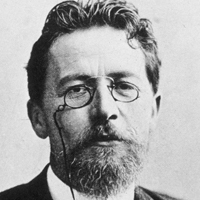
Anton Chekhov(1860-1904)
At every time in the chapter of social history, a single class can’t maintain its supremacy and privileged status. With a passage of time the old social order has to die yielding place to the new emerging social order. No society remains unchanged. Every society has to transform. Each society is bound to undergo change as time passes by. It is the very nature of society to undergo change. This law of social change is applicable universally in the world.
The late 19th century Russian society witnessed the soaring success of the capitalist middle class. At every step the middle class was on the rise. At all point this class was successful. The progressive march of this class was so strong that no obstacle was going to disturb it. Furthermore, the old feudal aristocracy was not only on the immediate decline, but on the verge of extinction without leveling any remnant of it. The old feudal social order was no longer in a tenable position to dictate its ethos and to impose its ideals and norms. Surprisingly enough, this class was totally ignorant and un- habituated to adaptive evolution. A new emerging class was head over heel in love with change, with progressive social transformation. But the old dying aristocratic class was allergic to change, antipathetic to change, and unprepared to embrace the costly social transformation.
In the play The Cherry Orchard, Lyobov and Gayev represent the dying aristocracy. Their heavy debt forced them to put their Orchard in the auction. Their orchard was sure to be lost. However, there was a route to save it by letting it on lease for the construction of summer cottages. There was a chance for the virtually dying class to live a life of adaptation and compromise. But this class was too proud to let their orchard on lease. Lyubov and Gayev were rather ready to leave the place that to see others possessing it. They fought their last battle in their hopeless and unsuccessful attempt to save the orchard. Finally, they failed. The orchard fell into the much more practical and sensible man, Lopakhin.
Lopakhin represents the victoriously emerging middle-class. A man of action he believes in the necessity to take the quick action man of vision he is far busier in the plan to rise above the underprivileged class through financial and practical success. Once he belonged to the working class. He was a servant in Lyubov’s house when he was a child. Through hard- work and practical line of thinking he succeeded in earning money. With the huge amount of money he earned, he succeeded in changing himself from the working class to the middle class. Economically he became so strong that he bought the Cherry Orchard of Lyubov at auction for the highest purchase. Even the aristocracy was attracted towards him. Lyubov offered her daughter Varya’s hand to him, but Lopakhin hesitated. If Lopakhin represents the practical middle class, Trofimov represents the theoretical and visionary ideals of the class committed to embrace.
Thus, the play The Cherry Orchard presents a social phenomenon which exemplifies the old decent feudal order giving way to the rapidly expanding capitalistic and mercantile middle class. As a mode of social realism the play represents the Russian society by the end of the 19th century. At that time the society was moving towards the threshold to change. Chekhov captured the reality concerning the social transformation. The displacement of Lyobov and Gayev on account of their failure to stand in the living of compromise and adaptation illustrates a golden fact that the early 20th century Russian society bade final adieu to the last remnant of decaying feudal structure. In most of Chekhov’s plays the feudal aristocrat is presented as bored, passive, dreamy and ridiculously ideal. This mode of characterization also reveals that this class has no right to occupy foreground in the social hierarchy of Russia. The middle class people are depicted as practical, sensible, painstaking, hard- working and radical as well. This line of characterization displays the fact that the playwright is in favor for the emergence of this class.
The Cherry Orchard Study Center
Conflict of Old Aristocracy and New Mercantilism in The Cherry Orchard
Romance and Love in Chekhov's The Cherry Orchard
A World in Transition in Chekhov's The Cherry Orchard
Individual Choice and Social Movements in The Cherry Orchard
The Cherry Orchard Study Center
Introduction of The Cherry Orchard
Plot Structure in The Cherry Orchard
Lybov Andreyevna in The Cherry Orchard
Chekhov's Style in The Cherry Orchard
The Cherry Orchard as a Tragicomedy
Tragedy of Futility in The Cherry Orchard
Symbolism in The Cherry Orchard
 |
bachelorandmaster.com |