Plato's The Allegory of the Cave: Meaning and Interpretation
Plato's The Allegory of the Cave is, one of the philosophical writings in the form of allegory. An allegorical writing is the type of writing having two levels of meanings: literary and allegorical meanings. A literary meaning is the content or the subject matter and allegorical meaning is the symbolic or metaphorical suggestion.
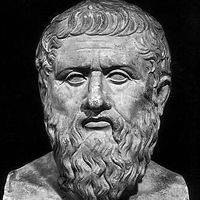
Plato (427-347 BC)
In allegorical writing characters, actions and setting are used as symbols and they should be interpreted to make the allegorical meaning. In the Allegory of the Cave, Plato has given a description of the cave of the cave world.
The cave is very dark because there is little light inside it and hardly seen the objects. There are some chained people on their necks as well as feet, these chained people cannot move easily. Similarly, there is also another world out of the cave world, but between these two worlds, a wall is raised. On the wall, many other people move with different things on their hands and their shadows fall in the cave world. The people inside the cave cannot raise their head completely so that they can only see the shadows like illusion, which they believe, as real but it is just their illusion.
In the outer world, there is light and everything is clearly visible. If one of the chained people is released from the cave world, and if he is taken to the outer world he cannot see anything at first because his eyes dazzle in the light. But if he stays in the outer world, slowly and gradually he begins to identify everything and he becomes to realize that the outer world is the real world and the cave world is the unreal world. He becomes gratified with himself and remembers the other people in the cave. He gives pity and sympathy over the cave people who are lost in darkness. He thinks that it is better to be the slave in the outer world rather than being the king inside the cave. Even though, he does not want to go back to the cave world, his eyes dazzle more if he is taken back to the cave world, and he can’t count anything inside darkness. If he attempts to persuade the people inside the cave saying that the outer world is the real world, and the cave world is unreal, his ignorant friends kill him.
The allegory of the cave has also allegorical meaning because so many symbolic suggestions are used in this writings. The dark cave symbolically suggests the contemporary world of ignorance and the chained people symbolize ignorant people in this ignorant world. The raised wall symbolizes the limitation of our thinking and the shadow symbolically suggest the world of sensory perception which Plato considers an illusion. In his opinion, the appearance is false and reality is somewhere, which we cannot see. Plato as an ideal philosopher says that the appearing world is just the imitation or photocopy of the real world. The shadows represent such photocopy and, the reality is possible to know with the spiritual knowledge. The chains symbolize our limitation in this material world so that we cannot know the reality to know reality; we have to break the material world. The outer world of the light symbolically suggests the world of spiritual reality, which we achieve by breaking the chains that are used to tie us. The dazzling of our eyes for the first time symbolizes difficulty of denies the material world. The second time dazzling of the eyes symbolizes our difficulty to accept ignorance after knowing the reality. Hence, in allegory of the cave Plato has given a criticism over our limited existence in the material world.
In Allegory of the cave, Plato has also described about our perception. He says that there are two types of perception: sensory perception and spiritual perception. Sensory perception is the world of appearance, which we perceive, with the help of our sensory organs. For this, world is the world of illusion. It is the world of shadows so in Plato’s view it is the world of falsehood. The reality or truth is impossible to perceive with our senses, it is possible through spiritual perception, which is divine enlightenment. Spiritual perception is possible when we reject the world of sensory perception so until and unless we break all the material chains we do not get spiritual perception. It is the ideal philosophy of Plato and his spiritual perception as an ideal concept.
Plato also talks about true education or true philosophy. In his opinion education is the process of learning spiritual knowledge so he even calls true education as true philosophy. He says that the learning power is the world of becoming and education is the process of learning called world of being. In other words, what Plato says is that each and every individual is given the learning power in to his soul by the divine so that our learning process differs from one another. A man can learn up to a certain limit and after the limitation is crossed, he cannot learn more. This concept of learning process differs from one another. Contemporary professors of education who believed that there is not predetermined, rejected this concept of learning process that true education is the spiritual enlightenment, which we learn from the heart. It is also called true philosophy, which has certain qualities. A true philosophy is able to make the difference between truth and falsehood, right and wrong as well as justice and injustice. More over true philosophy makes a person spiritually illuminated so that he is not concerned with the material world.
Plato also talks about an ideal state, which is a utopian world. In an ideal state, there is equality among the people because no one is superior or inferior in this world. There is free flow of knowledge justice and truth, everywhere in the ideal state. Plato is also known as the first communist because of his concept of equality among the people. In the ideal state, rulers are also true philosopher whose wealth is not money or gold but spiritual knowledge. Those are the best rulers to rule the ideal state because they are reluctant to rule and active to serve the people as true servants. In other words, the rulers at the ideal state are never thirsty to exercise power, they do not want to impose cruelty over the people but instead they are worried of the condition of the people and the welfare of the state. These rulers are based because for them ruling is not imposing power but it is serving the people. But it is just an ideal state so practically there is not possibility of such state as such ideal rulers are rarely found, these true philosophers are not only the rulers but also best teachers, who should go to the dark and ignorant world to enlightenment the ignorant people.
Browse by Question
Browse by Topic
Nietzsche's Apollonianism and Dionysiansism: Meaning
Marx's The Communist Manifesto: Interpretation
Russell's A Free Man's Worship: Interpretation
Jefferson's Declaration of Independence: Interpretation
Freud's Letter to Einstein: Meaning and Interpretation
Camus's The Myth of Sisyphus: Interpretation
Tarnus's The Postmodern Mind: Interpretation
Gaarder's The Renaissance: Meaning and Interpretation
Gaarder's Romanticism: Meaning and Interpretation
The Allegory of the Cave Study Center
Brief Summary on The Allegory of the Cave
Critical Note on The Allegory of the Cave
 |
bachelorandmaster.com |